CRO Without A/B Testing: How to Improve Conversions on a Low-Traffic Site
Most conversion advice assumes you can run an A/B test: split your traffic, show half of it a new version, and wait for a clear winner. On a small site, that wait can stretch for months, and the result is often "inconclusive."
That doesn't mean you can't improve your conversion rate. It means you need a different method: one that relies on evidence about what visitors do, careful changes, and honest measurement, instead of a statistical test you can't afford to run. This guide lays out that method step by step.
Why A/B tests stall on smaller sites
An A/B test works by comparing two groups of visitors. To tell a real difference from random noise, each group needs enough visitors and enough conversions. The smaller the improvement you're trying to detect, and the lower your current conversion rate, the more visitors you need.
You can see this for yourself. Plug your own numbers into a free tool like Evan Miller's sample size calculator: your current conversion rate and the smallest lift you'd care about. Then divide the visitors it asks for by your weekly traffic. If the answer is "most of a year," you have your answer.
Stopping early because one version "looks like it's winning" doesn't fix this. Early leads on small samples come and go.
So on a low-traffic site, the question shifts from "which version won?" to "what is most likely wrong, and did fixing it move things in the right direction?"
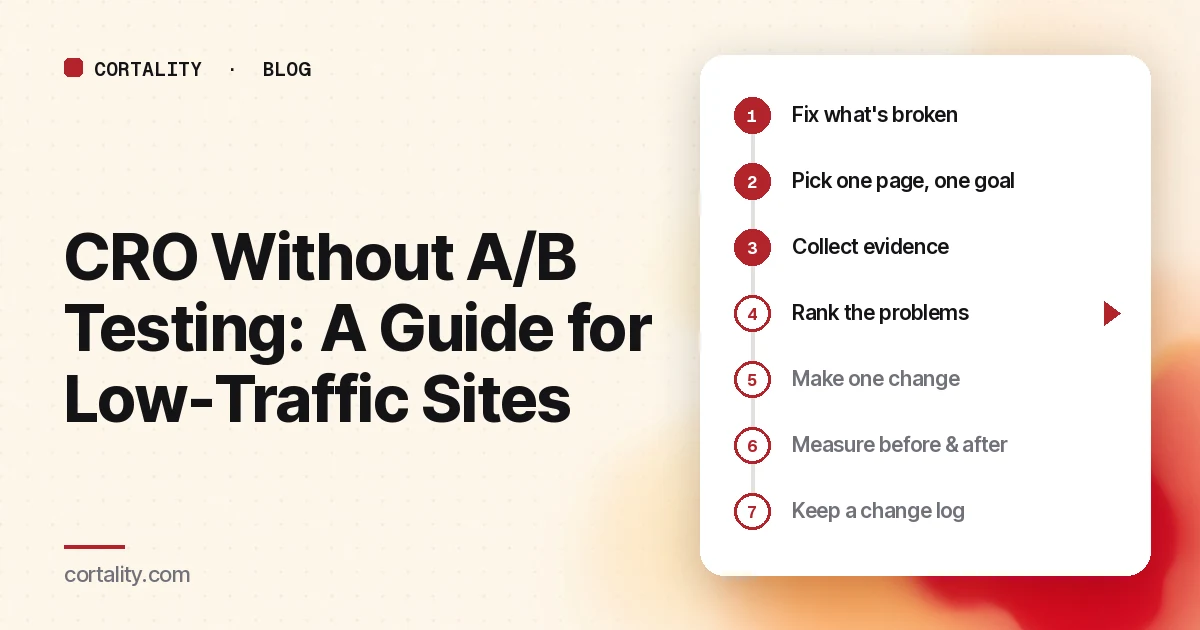
What to do instead: a 7-step process
Step 1: Fix what's broken before you optimize
Some problems don't need a test because they're simply bugs. Check these first:
- Submit every form yourself and confirm the lead arrives.
- Click every button and link on the page, on desktop and on a phone.
- Make sure your analytics records the conversion.
- Check that the checkout or booking flow works with a real card, a coupon, and a typo in the email.
A broken form or a button hidden behind a cookie banner is not a hypothesis. Fix it today.
Step 2: Pick one page and one goal
With limited traffic, spreading effort across ten pages means nothing gets enough data. Pick the page with the most visitors who could convert, often your homepage, main landing page, or pricing page.
On a Shopify store, that's usually your busiest product page, and our Shopify product page audit lists what to check on it.
Then pick one goal for it: booked calls, trial signups, purchases, or form fills. Write it down. Every later step is judged against that single number.
Step 3: Collect evidence, not opinions
Use several sources of evidence and look for where they agree.
- Behavior data. How far do visitors scroll? Which parts of the page do they spend time on, and which do they skip? Where do they leave? Your analytics and any behavior tool you use will show some of this.
- Session recordings. Watch a batch of real sessions in one sitting. Note where people pause, scroll back up, tap something that isn't a link, or leave.
- Customer words. Email recent customers: "What nearly stopped you from buying?" Ask leads who didn't buy why not. Read your support emails and sales call notes for repeated questions.
- On-page questions. A one-question poll ("What's stopping you from signing up today?") on your key page can surface objections you hadn't thought of.
One person's comment is an anecdote. The same issue showing up in recordings, customer emails, and your scroll data is evidence. If you'd rather pay someone to gather it, here's what a CRO audit costs, from published prices, and what to ask before you buy one.
Step 4: Rank the problems
You'll end up with a list of possible problems. Rank them before you touch anything. A simple way is to score each one on three questions:
- Reach: how many visitors does this affect? A problem in the first screen affects everyone. A problem in the footer affects few.
- Confidence: how many independent sources point to it?
- Effort: how hard is the fix?
Work from the top: high reach, high confidence, low effort. If you need ideas for what to look for, here's a list of the 10 most common leaks, in the order visitors hit them.
Step 5: Make one change you can describe in one sentence
"We moved the booking button above the testimonials on mobile." "We cut the form from six fields to three." "We rewrote the headline to match the ad."
If you can't describe the change in one sentence, it's probably several changes, and you won't know which one did what. Bigger, clearer changes are also easier to detect than small tweaks. On low traffic, a new button shade is unlikely to show up in your numbers. Fixing a headline nobody understands might.
Step 6: Measure before and after, carefully
Before-and-after measurement is weaker than an A/B test, but you can make it far more trustworthy with a few rules:
- Decide the metric in advance. Pick it before you see the results, so you can't go looking for whichever number improved.
- Use equal windows. Compare the same length of time before and after, covering the same days of the week.
- Keep everything else still. Don't launch a new ad campaign, run a sale, or change other pages during the window.
- Check the traffic mix. If your traffic sources shifted between the two periods, the comparison is skewed.
- Look at the step, not just the end. If you moved a button, did more people reach and click it? Measuring the behavior closest to the change gives you a clearer signal than waiting for final sales.
- Accept "not enough data yet." It's a valid result. Keep the change running and look again later instead of forcing a verdict.
Step 7: Keep a change log
Keep a simple spreadsheet: date, page, what changed, why, the metric you watched, and what happened. You'll stop repeating failed ideas, you can explain a dip months later, and you'll build a record of what works for your audience.
The traps of before-and-after measurement
Be honest about what can fool you:
- Seasonality. Holidays, month-end, and industry cycles shift behavior on their own. Black Friday is the extreme case: compare it with last year's Black Friday, not an ordinary week (see our Black Friday product page checklist).
- Outside events. A mention in a newsletter or a competitor's price change can move numbers without your page changing.
- Bounce-back. If you made a change right after an unusually bad week, the next week may look better no matter what you did.
- Wishful reading. If you designed the change, you want it to work. Write down your success rule before you look.
None of these make before-and-after useless. Treat results as strong hints and keep watching.
When you're ready for A/B testing
As traffic grows, rerun the sample size calculator every few months. When a test can finish in a few weeks, start testing your biggest decisions, and keep using this process to pick what to test. A/B tests tell you which version won. They don't tell you what to try in the first place.
The checklist (copy this)
- I checked my sample size and confirmed A/B testing isn't practical yet
- Every form, button, link, and checkout step works on desktop and phone
- Analytics records the conversion
- I picked one page and one goal, and wrote them down
- I gathered evidence from at least three sources (behavior, recordings, customers, polls)
- I ranked problems by reach, confidence, and effort
- My next change can be described in one sentence
- I chose the success metric before making the change
- My before and after windows are equal and cover the same days of the week
- Nothing else big changed during the window
- I logged the change, the metric, and the result
Where Cortality fits
Steps 3, 4, and 6 are where most small teams get stuck: gathering enough evidence, ranking it, and measuring whether a fix worked. That's the part Cortality is built for, specifically for sites that can't run A/B tests to significance. Here's how our landing page CRO audit works, from the free scan to measured re-checks.
If you want a free place to start, our free page leak scan shows where your page is likely losing buyers and what fixing it could be worth. It takes about a minute, with no install or card. It's a prediction from our attention model, not data from your real visitors, so use it to decide where to look first.
The paid product measures how real visitors use every part of your page and gives you a ranked list of fixes, each with the exact change to make. After you make a fix, Cortality re-measures and gives a verdict: improved, worse, no change, or not enough data yet. Read how the measurement works or see what a finding looks like.
Your first week is free and you see your first report before you pay. You save a card at signup, and nothing is charged until 3 days after your first report, which arrives once your page has 100 visitors. If your site can't reach that by day 30, you're never charged. You can cancel before the first charge and pay nothing, and any charge can be refunded within 14 days (refund policy; how the free week works).
FAQ
Can you do conversion rate optimization without A/B testing?
Yes. Collect evidence about what visitors do, rank the problems, make one clear change at a time, and measure before and after with equal windows and a metric chosen in advance. It's less certain than a proper A/B test, but it's far better than guessing or redesigning everything at once.
How do I know if I have enough traffic to A/B test?
Put your current conversion rate and the smallest improvement you care about into a sample size calculator. Compare the visitors it asks for with your weekly traffic. If the test would take months, use the process in this guide instead.
Is before-and-after testing reliable?
It's reliable enough to act on if you use equal time windows, keep other changes still, and pick the metric in advance.
What should I change first on a low-traffic site?
Start with anything broken, then the problem that affects the most visitors and has the most evidence behind it. That's usually something in the first screen, like an unclear headline or a button people don't see.
Does Cortality work if my site has very little traffic?
Your first report arrives once your page has 100 visitors. If the site can't reach that by day 30, the trial ends and you're never charged.